
Gator’s Game Overview
Navigating “Marbleous”
Designed by Mads Fløe and Kåre Torndahl Kjær
Published by KOSMOS
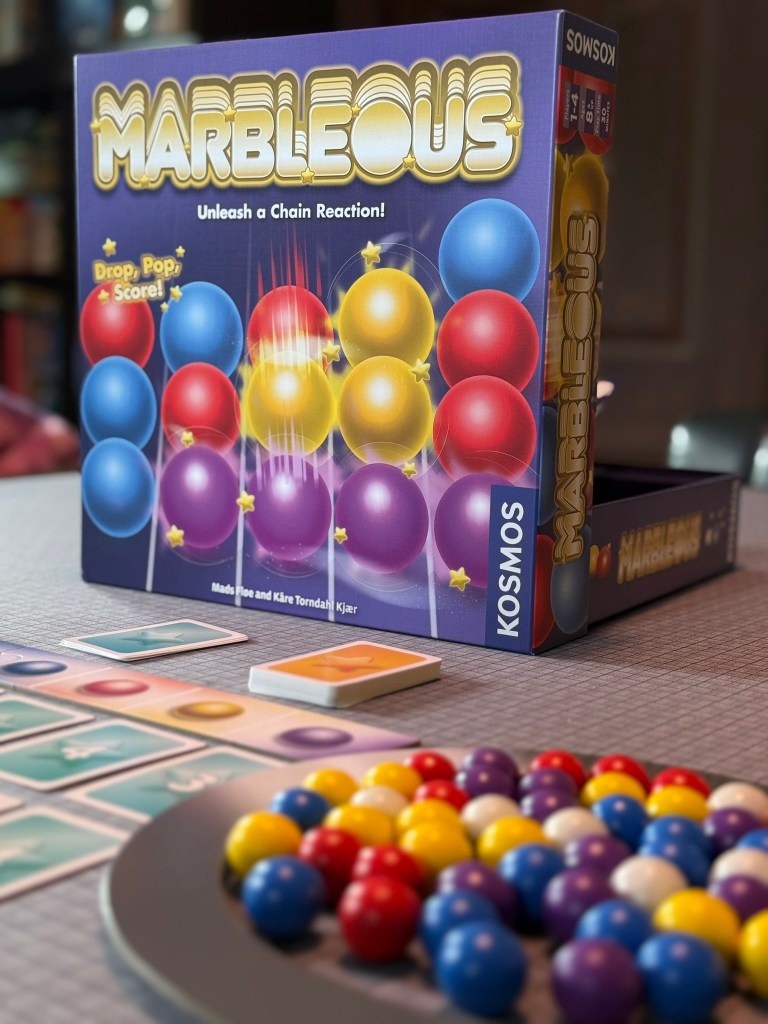
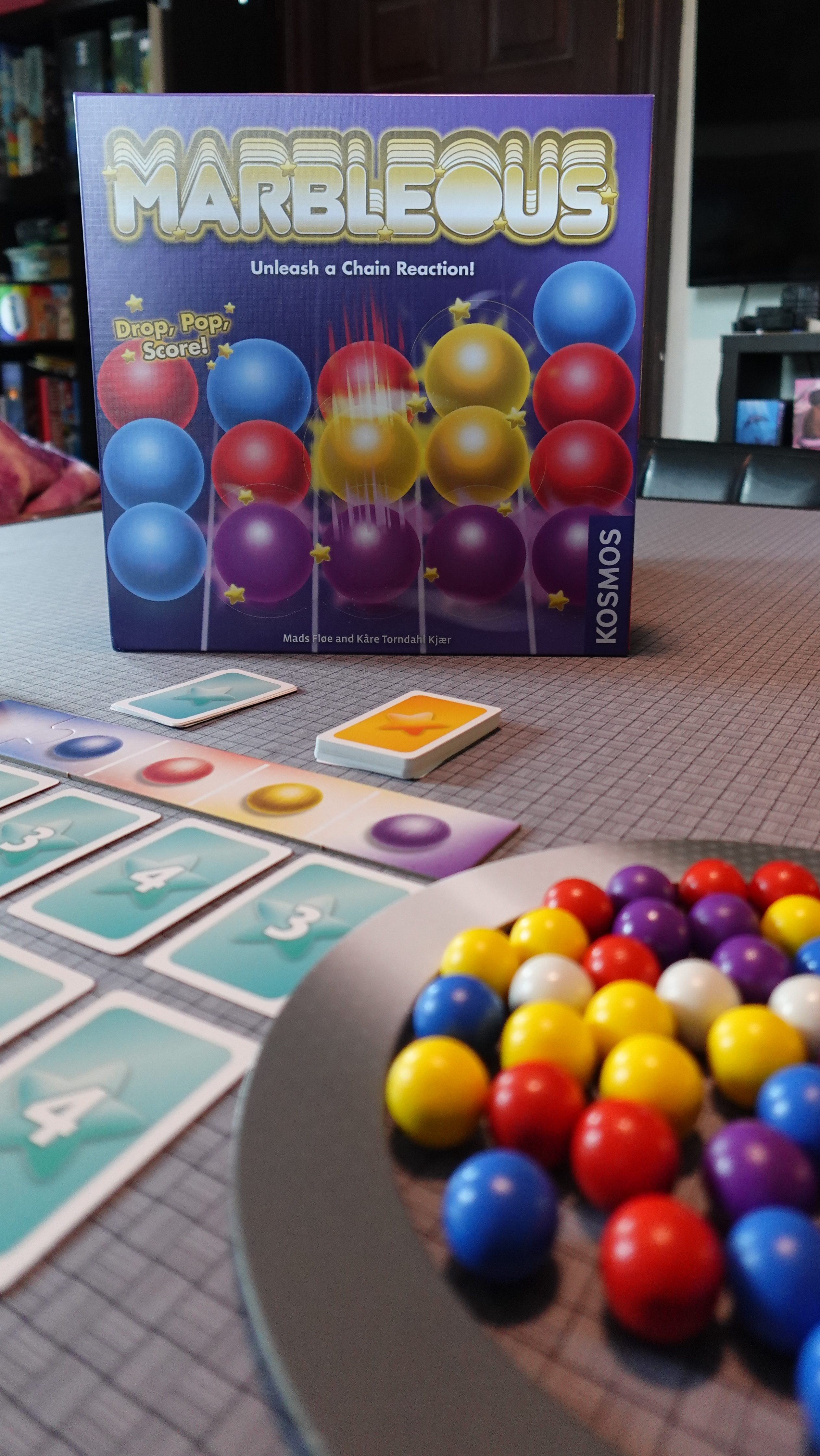
Marbleous brings classic games like “Bubble Pop” to the table in a tactile, physical form. Each player draws cards indicating which 2-3 colored marbles to take and drops them in their player tray. If the player connects 3 or more colors, those POP! and earn points. Once those are removed, and if another reaction of 3+ colors sets off, then POP! That new set also earns points! The player with the most points wins the game.
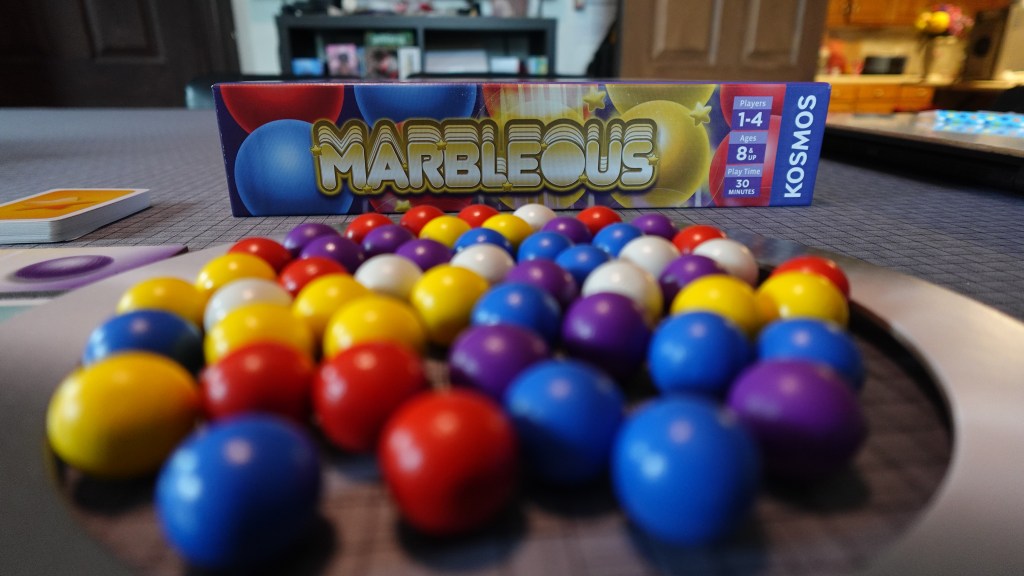
Key Coordinates
Players: 2-4
Play Time: 30 minutes
Ages: 8+
Mapping the Mechanics
Setup
Setting up a game of Marbleous is quite simple. First, you must piece together the three gameboard parts—this is quick and easy. Next:
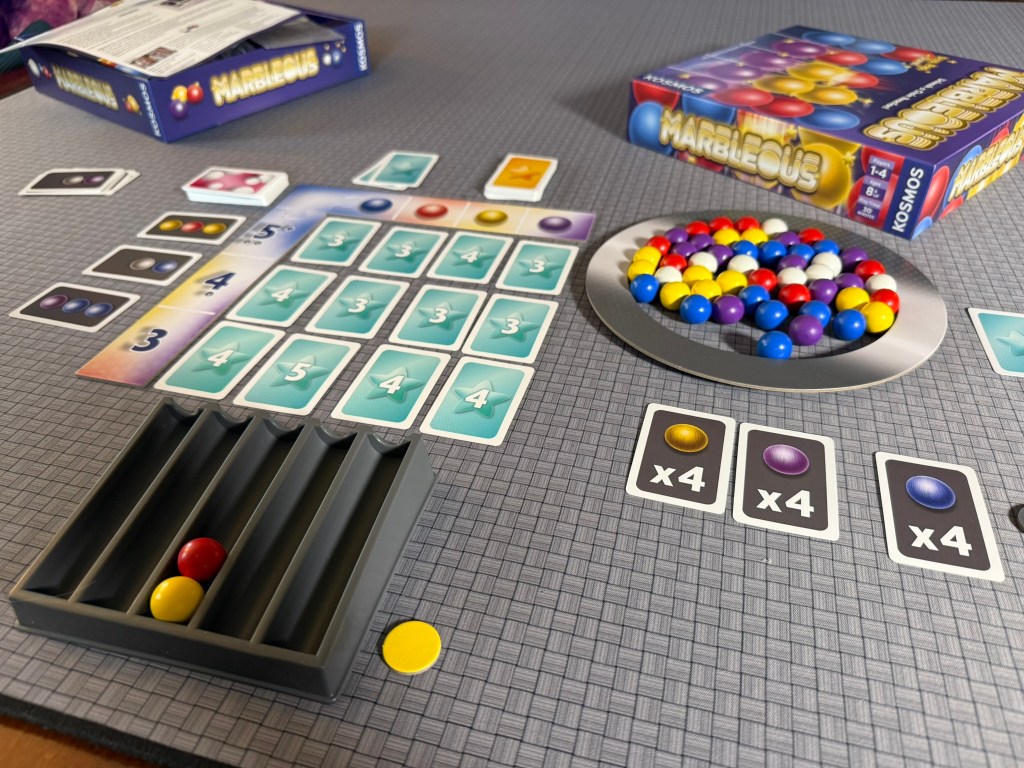
- Draw 12 blue star point cards and fill them in the gameboard grid area.
- Take the bonus token supply and ensure all are flipped down.
- Pass two bonus tokens to each player, a marble tray, and one white marble in the middle of your tray.
- Flip three marble cards face up.
- Fill the marble supply circle with all the marbles.
You’re ready to begin!

Gameplay
- Draw one Marble Card from the three choices on each turn. You can rotate the card in any direction that is most beneficial for you.
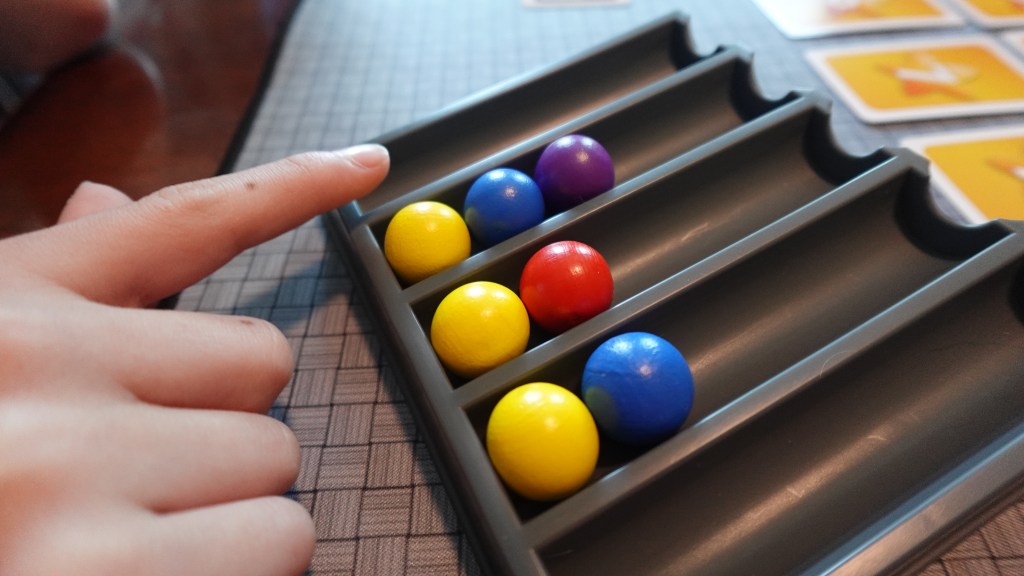
- Drop the marbles shown on the card, in that order, to your marble tray.
- When the last marble is placed, you can use your bonus token. Declare which color from your collection you are using, and put it into your tray (only once per turn on this).

POP and Scoring
Now, the fun part: it’s time to POP and score.
- The active player looks at their tray and sees if three or more marbles, including your white wild one, are touching.
- If there are, pop those off, remove them from your tray, and score! Look for the matching column and row of the marble and take that point card.
- Managed to pop off 4 marbles? Take an extra bonus token. If you can pop 5 or more, grab two extra bonus tokens.
- As the marbles slide down, if you create another group of 3+, it’s time to pop and score again.
For example, if you have 3 adjacent blues, find the blue column on the game board grid, the “3” row, grab that points card, and remove the 3 blues. Repeat the steps if you set off another set of colors (like 4 reds, for instance). Do this until you run out of marbles to score.
Navigator’s Notes
The Journey’s Feel: Marbleous offers a hands-on, real-life game version of many digit matching games, such as Bubble Pop or Candy Crush. As board gamers, it’s safe to say we find the physical versions of games usually more entertaining than the pixel-digital versions. Sitting at the table playing Marbleous creates the relaxing environment you’d come to expect from a casual game like Bubble Pop and replaces it with pleasing tactile and personal interactions.
In my house, the game provides enjoyment for many ages. My 8-year-old quickly learned the rules and started honing his planning and pattern-creation skills; my teenager enjoyed devising as many chain reactions as he could manage, and we adults found it pleasant as a low-stress strategy game.
One game that probably comes to mind for most hobby gamers is a similarity between “Potion Explosion.” While I do thoroughly enjoy Potion Explosion, I will say that Marbleous is more accessible to a variety of players and skill levels. The rules are straightforward, eliminating the juggling of additional mechanics or icons to memorize. Instead of trying to remember, “I have this potion that can do this, I have that potion that can trigger that — oh shoot, someone ruined the display of balls, so now my plans are wrecked!” Marbleous keeps it streamlined and allows players to focus on their patterns instead of disrupting another player’s plans. This change creates a more unrestricted game for younger or newer players.
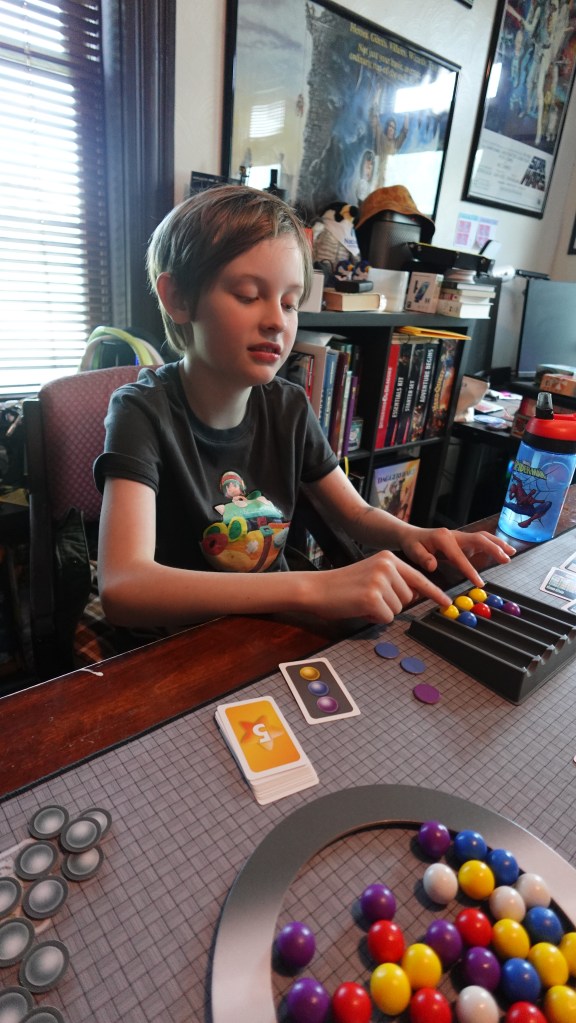
Marbleous Encounters: Watching the marbles fall into place and complete chain reactions creates excitement and satisfaction. Even when it isn’t your turn, I found viewing another player’s chain reaction set off amusing. Of course, the most joy comes from popping your own marbles, and you can’t help but feel like you’ve just conquered the game by matching marbles and stacking a considerable amount of points in one turn. It’s nice to finish your turn and think, “That felt like a good play!”

Strategic Depths and Tactical Choices: Marbleous gains another point in the win column versus digital games through the choices you can make. Three Marble Cards in each round provide more strategic control to decide what works best for your plan instead of a randomized, one-color choice. You can start to see and prepare in advance how to place marbles in a pattern to create larger groups in succeeding turns. There’s usually a choice: do you go for the smaller group now and possibly take fewer points, or hold out for a larger group, likely more points and bonus tokens. It also helps the game move quickly, giving players less downtime between turns. As the game progresses, those point cards slide down, and higher point cards are replaced at the top, making the larger POP reactions even more valuable.
If you play a few times and need more of a challenge, an advanced mode gives additional points through star tokens for two or more sets that popped.
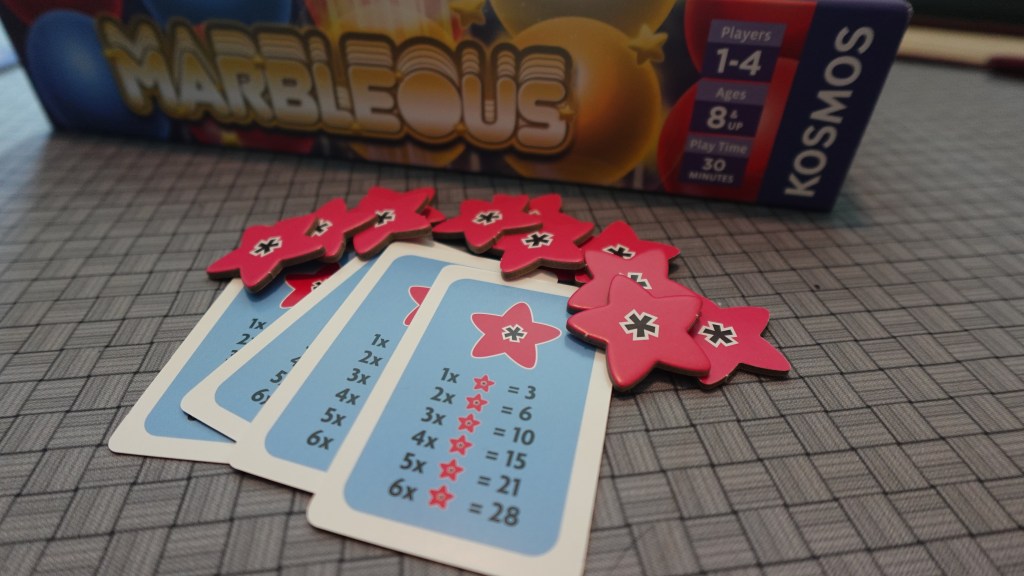
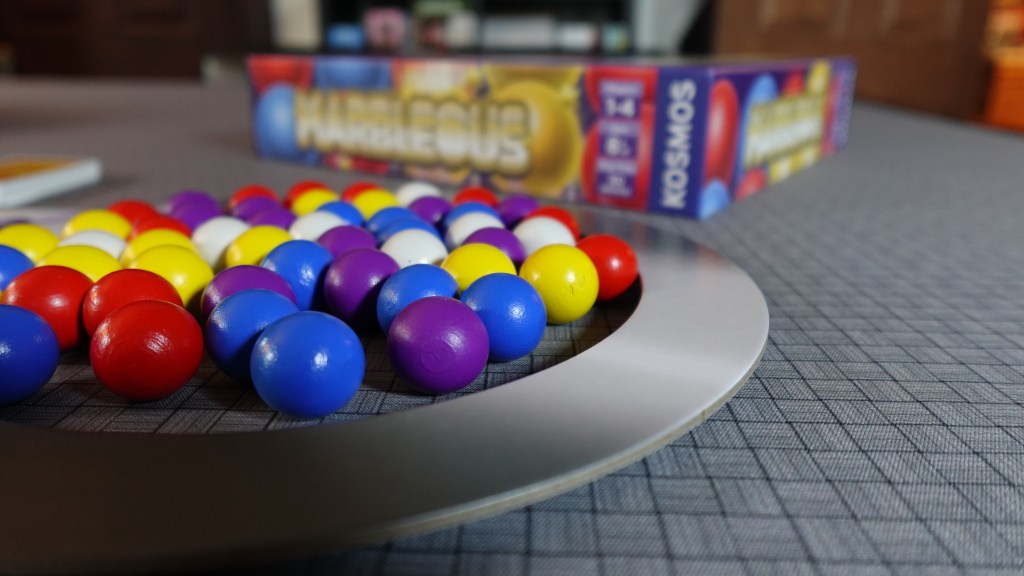
Visuals, Vessels, and Treasures: Marbleous has a delightful array of colors, making the game visually appealing. As the colored marbles fill your tray, it almost becomes a shame to pop them and bring your tray back to the simple gray—until you recall you’re about to get a bunch of points, which makes it worthwhile! It feels like I’ve brought the rainbow world of Bubble Pop games to my game table from the game board, point cards, and marbles in the tray.
The game box contains 52 marbles, and it is surprisingly light. The marbles are lightweight, seemingly made from wood material instead of the clunky, clanky traditional marbles. This was a clever manufacturing move on KOSMOS’ part, cutting down on the weight (I mean, have you felt a bag of marbles lately? They aren’t light!). Granted, this sometimes means the marbles can more easily get away from your hands, but I’d still take the lighter-weight design. Once placed into the game tray, though, they’re nicely snug in place.

Flying Solo
Albatross’s Assessment: If you enjoy solo variants, I’m happy to inform you that Marbleous succeeds in their Solo Mode. It’s just as easy to set up as a standard game. It offers a little extra challenge to complete an additional set of 4+ pops of each marble color during the game. This setup is randomized, forcing me as the solo player to plan out my moves by focusing on, for example, Purple 4+ first to complete the Solo card. Sure, I can complete Red 4+, but I can’t claim the Solo Card until the first one is completed. On top of that challenge, they also give three levels of difficulty and three levels of difficulty in the advanced mode. The mix-and-match of easy/medium/hard and the advanced version provides plenty of play combinations in the Solo Mode.
Who Should Embark?
Marbleous is a great family-friendly game. Younger children will enjoy the tactile excitement of placing colorful marbles and scoring points, while adults will find a soothing calm in pattern creations.

The Navigator’s Chart
Calm Coastline: A light and easy-to-learn game, perfect for casual play or introducing new gamers.
End of the Voyage
And so, our Marbleous adventure drops anchor! This game is a treasure chest of tactile joy and clever chain reactions, proving itself a compass to casual fun for everyone. It successfully charts a course for smiles and smart plays without the rough seas of complex rules. If you’re looking for a delightful new addition to your crew that promises satisfying pops and engaging moments, embark on your Marbleous journey here!
A special thanks to KOSMOS for generously providing a copy of Marbleous.



 Navigator Lana
Leave a comment